Overview of Legal Power Limits for Airguns Across Major European Countries
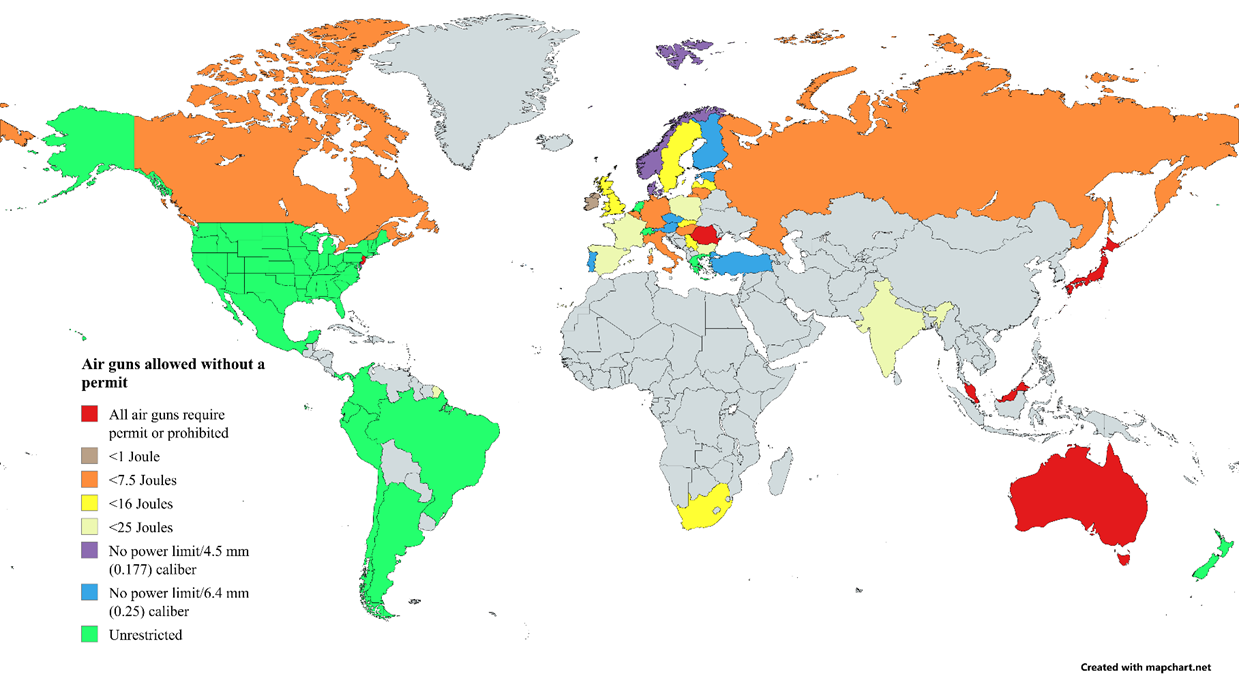
Airguns occupy a unique legal space in Europe. They are widely used for sport shooting, training, pest control, and recreation, yet their regulation varies significantly from one country to another. The key legal factor almost everywhere is muzzle energy, usually measured in joules (J). Staying within the permitted power limit often determines whether an airgun can be owned freely or requires a firearms license.
Below is a clear, country-by-country overview of the maximum power allowed for airguns in major European countries, focusing on the limits most relevant to civilian sport shooters and hobbyists.
United Kingdom
Limit: 16.27 J (12 ft·lbf) for rifles / 8.1 J (6 ft·lbf) for pistols
The UK is one of the most airgun-friendly countries in Europe. Air rifles up to 12 foot-pounds and air pistols up to 6 foot-pounds can be owned without a firearms certificate in England and Wales (rules differ in Scotland). This relatively high limit explains the strong airgun culture and competitive scene in the UK.
Germany
Limit: 7.5 J
Germany enforces one of the strictest power limits. Airguns up to 7.5 joules are legal without a firearms license and are marked with the well-known “F-in-pentagon” symbol. Anything above this threshold is considered a firearm and requires licensing. As a result, the German market is highly specialized in precision low-power air rifles.
Italy
Limit: 7.5 J
Italy follows a similar model to Germany. Airguns producing no more than 7.5 joules are considered low-power and can be purchased freely by adults. Higher-powered airguns must be registered and may require a firearms license. This limit has shaped a strong market for accurate, competition-oriented air rifles designed specifically for the Italian legal framework.
France
Limit: 20 J
France allows airguns up to 20 joules without a firearms license for adults. This relatively generous limit makes France one of the more flexible European countries for airgun enthusiasts. Above 20 joules, airguns are classified as regulated weapons and require official authorization.
Spain
Limit: ~24 J (with registration)
Spain has a more nuanced system. Airguns are categorized as 4th-category weapons and must be registered with the local town hall, regardless of power. In practice, air rifles up to around 24 joules are commonly accepted for civilian use, but local regulations and enforcement can vary. Membership in a shooting club is often required.
Portugal
Limit: 24 J
Portugal allows airguns up to 24 joules without a firearms license, although registration may still be required. This places Portugal among the more permissive countries in Southern Europe when it comes to airgun power.
Netherlands
Limit: No fixed joule limit (restricted use)
The Netherlands has no clearly defined joule threshold. Instead, airguns are legal to own but heavily restricted in terms of use. Shooting is generally limited to approved clubs or ranges, and public or private backyard shooting is often prohibited. Practical legality depends more on location than raw power.
Belgium
Limit: No fixed joule limit (ownership allowed)
Belgium allows adult ownership of airguns without a license, with no specific power limit defined in law. However, misuse or unsafe handling can quickly lead to legal trouble. Transport and use must be discreet and responsible.
Poland
Limit: 17 J
Poland sets the license-free limit at 17 joules. Above this level, an airgun is considered a firearm and requires proper authorization. This threshold supports a growing sport shooting community while maintaining regulatory oversight.
Czech Republic
Limit: 16 J
The Czech Republic allows airguns up to 16 joules without a firearms license. The country has a long-standing shooting tradition, and airguns are commonly used for both training and recreation.
Airguns vs. Airsoft: Different Legal Logic
It is important to distinguish between airguns and airsoft replicas. Airguns fire metal pellets or BBs and are regulated primarily by power. Airsoft replicas fire lightweight plastic BBs and are typically regulated by muzzle velocity and intended use rather than joules.
In most European countries, airsoft guns fall under less restrictive categories due to their lower energy output and sporting nature. For those interested in both disciplines, understanding the legal distinction between airguns and airsoft guns is essential before purchasing or using any replica.
Why Power Limits Matter
Power limits are not arbitrary. They reflect each country’s balance between public safety and sporting freedom. Staying within legal limits ensures:
- No firearms license is required
- Easier purchase and ownership
- Fewer transport and storage obligations
- Wider access to clubs and ranges
For beginners especially, choosing a compliant airgun avoids unnecessary legal complications and allows focus on technique and enjoyment.
Europe does not have a single standard for airgun power limits. From Germany’s strict 7.5 joules to France’s 20 joules and the UK’s unique system, each country reflects its own legal and cultural approach to shooting sports.
Before buying or using an airgun, shooters should always verify local regulations and choose equipment designed for their national framework. Understanding these limits is not just about legality—it is about responsible ownership and preserving the future of air-powered shooting sports across Europe.